


Nervous System Literacy Should Be As Important As Maths & English Literacy
A STRATEGIC IMPERATIVE FOR EVERY SCHOOL
You’ve probably got this covered already with a behaviour policy, safeguarding training, pastoral support, maybe trauma informed CPD already on the calendar and you already know there’s still a piece missing. It isn’t leadership. It isn’t wellbeing. It’s Nervous System Literacy which is the universal language that runs from the lunch hall to the leadership team meeting.
What Is Nervous System Literacy?
Nervous System Literacy is the universal language for how the body responds to stress and safety and the ability to notice the physical signs of activation and shutdown, and to use simple, practical tools to return to regulation even in the presence of pressure, stress and challenge.
By observing how nervous system states are expressed through voice, physiology, behaviour and human connection, Nervous System Literacy equips teachers and school leaders to recognise what words alone cannot reveal. This enables them to respond to the child, their team, their colleagues and not just the presentation.
Our methodology is designed to make Nervous System Literacy practical, memorable and actionable, rather than teaching theory alone. We provide a series of interconnected frameworks that help people recognise, understand and respond to nervous system states in everyday life creating a Shared Language that runs consistently through the whole school, from reception to the senior leadership team.

Embodied Awareness.
Learning to name what’s actually happening in the body from shallow breathing, heat, fatigue, a racing heart before reacting on autopilot.

Embodied Awareness.
Understanding that fight, flight and freeze are intelligent survival responses not personal flaws or character failings and not a sign that someone is bad at their job.

Every Age, Every Role
This isn’t a programme for one year group or one job title. It’s a universal language for the whole school community from reception pupils and sixth formers, teaching assistants and heads of department, lunchtime supervisors and the senior leadership team. A four-year-old who bites and a seventeen-year-old who walks out of an exam are often communicating the same thing, in the only way their nervous system has available to them at that age.
Traffic Lights of Tolerance™
RECOGNISE THE STATE

SHUT DOWN
BEHAVIOURS
- Withdrawn, “invisible” in class
- Work refusal that looks like laziness
- Staring into space, struggles to follow instructions
- Can’t recall what’s just been taught
- Reluctant to ask for help
- Avoids group work or being noticed
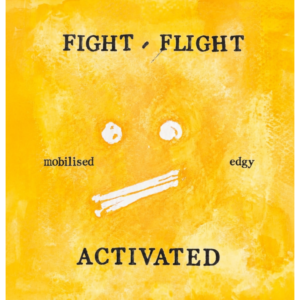
ACTIVATED
BEHAVIOURS
- Quick to anger, back-chat
- Disruption, difficulty sitting still
- Low-level chaos, testing boundaries
- Overreacts to small setbacks
- Struggles with multi-step instructions
- Conflict with peers escalates fast………………
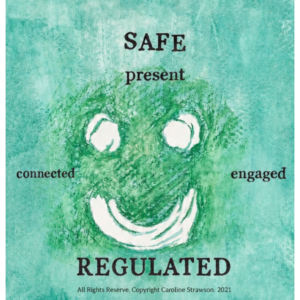
REGULATED
BEHAVIOURS
- Engaged and able to learn
- Asks for help when stuck
- Recovers from setbacks without shutting down
- Follows routines, even difficult ones
- Forms and maintains relationships
- Resolves conflict without escalation
The Data You’re Already Collecting
Every school already tracks attendance, behaviour incidents and exclusions. Read through a nervous system lens, that data stops being a list of problems to manage and starts being a map of where regulation is breaking down and for whom. Nervous System Literacy is how you finally use it.
Capacity Under Pressure™
Every person has a capacity, a cup that can hold a certain amount before it overflows. What changes is not the pressure, but the size of the cup and how full it already is before the next demand arrives.
Most people assume the goal is a calm classroom. It rarely is with thirty different children, needs and moods in one room. The real goal is capacity which is a school’s ability to hold real stress and still stay regulated. Nervous System Literacy also means staff and pupils can notice what’s happening in themselves in the moment, so they get to choose how they respond, rather than automatically react.
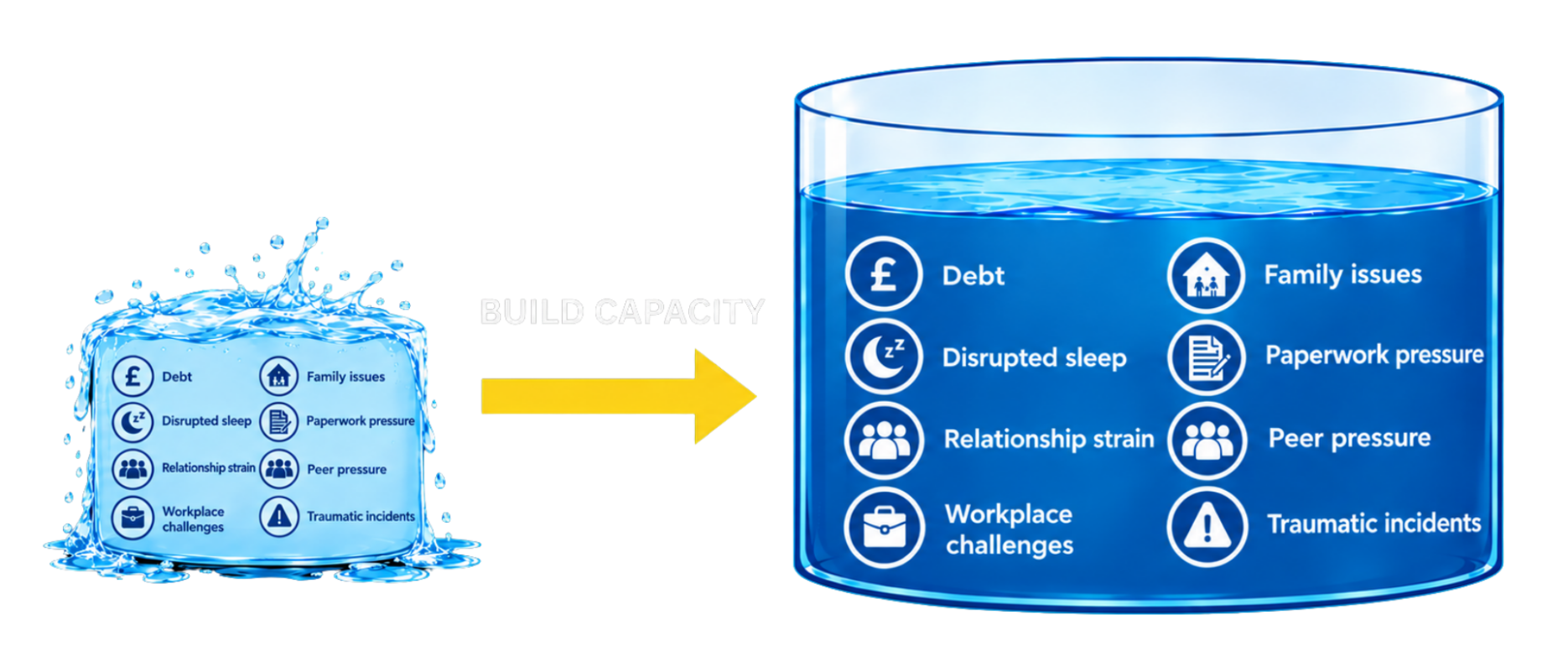
The cup is illustrative.
What fills it changes depending on who’s carrying it.
For a teacher, that cup might be holding a full marking pile, a growing safeguarding caseload, a difficult parents’ evening conversation, an inspection looming, and exam pressure absorbed on behalf of thirty children who don’t know it’s happening.
For a head teacher, it might also be holding budget pressure, staff absence they can’t cover, and a governing board asking for answers.
None of that shows up in a lesson observation.
All of it shows up in the staffroom, and in the classroom, the next time something goes wrong.
Building capacity does not remove what sits in the cup.
It changes how regulated someone is in the way they carry it so they are more likely to stay present and de-escalate, rather than let the situation intensify.
HOW IT SHOWS UP
Staff Absence
19% OF TEACHERS EXPERIENCE HIGH WORK STRESS
The same time of year, cover harder to find each term as the cup is never emptied between peaks.
Exclusions
2× MORE LIKELY TO WANT TO LEAVE
A spike that tracks with exam pressure, inspection windows, or a change no one had the capacity to absorb well.
Parental Conflict
1 IN 7 TEENS EXPERIENCE A MENTAL HEALTH DISORDER
A complaint escalates fast because the parent, the teacher, or both, were already closer to full before the conversation began.